What is a Differential Steering Transfer Cart?
Definition:
A Differential Steering Transfer Cart is a highly flexible transport device designed to move heavy objects within factory workshops. It is battery-powered, with motors driving the wheels to move the cart. It is suitable for transporting heavy materials in large workshops, port terminals, the steel industry, and similar scenarios.
How Does Differential Steering Work?Let's take a look at the picture below. It clearly shows how it works.
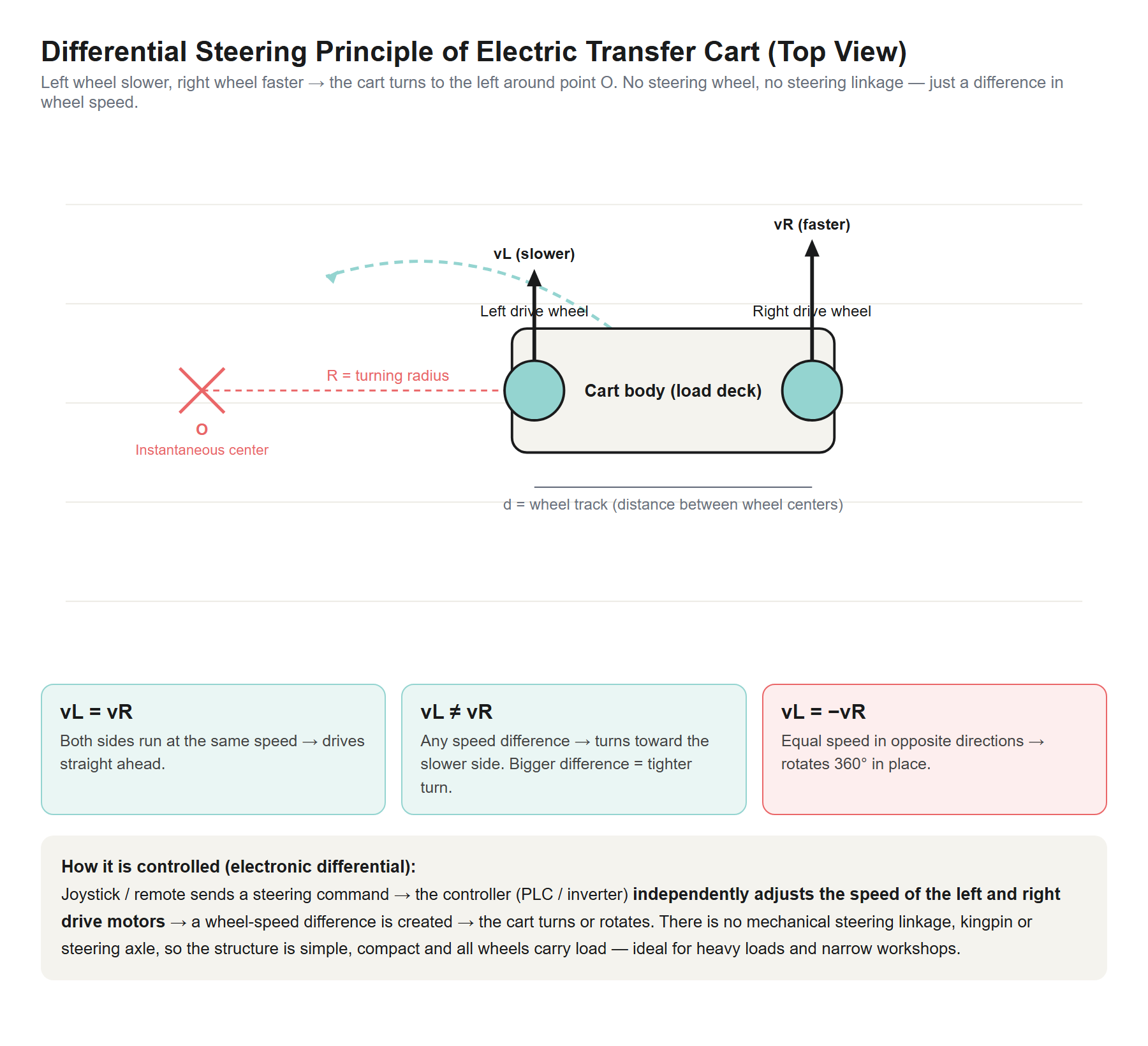
Its most notable feature is the differential steering system, which achieves directional control through speed differences between the two drive wheels. This enables it to perform straight-line movement, 360-degree rotation, left and right turns, and more, giving it excellent maneuverability and adaptability.
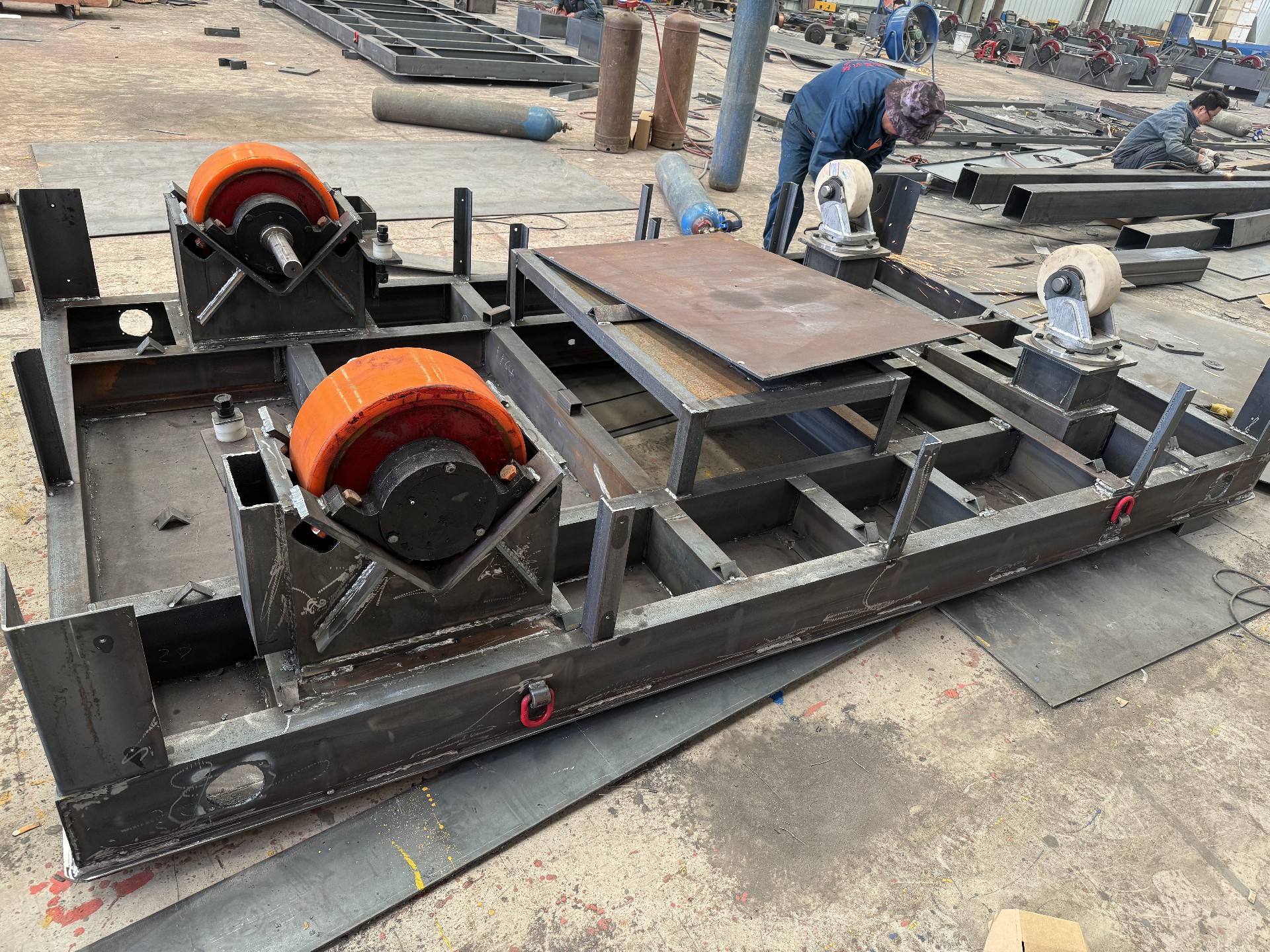
From the picture, you can clearly observe the mechanical structure of this differential steering transfer cart. It is fitted with two universal steering wheels+2 drive wheel that enable full 360° rotation. This design allows the whole cart to turn freely and even spin in place without extra turning space.
| Comparison Item | Hydraulic Steering | Differential Steering |
| Steering Principle | Hydraulic cylinders steer the wheels around the vertical axis by a certain angle, similar to the front wheels of a car or forklift. | Steering is achieved by the speed difference between the left and right drive wheels. |
| Steering Mechanism | Hydraulic push rods, hydraulic cylinders, hydraulic power unit, oil pipes, valve blocks, etc. | Two independent drive motors and controllers. |
| Turning in Place | Cannot turn in place. Sufficient space must be provided for turning, with a minimum turning radius. | Can rotate 360° in place. When the left and right wheels rotate in opposite directions (vL = −vR), the turning radius can be zero. |
| Turning Radius | Determined by the maximum steering angle of the wheels; a minimum turning radius exists. | Adjustable; the minimum turning radius can be 0 m. |
| Tire & Floor Wear | Wheels roll with minimal sliding, resulting in lower wear. Suitable for relatively higher speeds and longer travel distances. | During in-place or small-radius turns, the tires experience sliding friction against the floor, resulting in higher tire and floor wear. |
| Hydraulic Oil / Leakage | Uses hydraulic oil, seals, oil pipes, and other components, which require regular inspection and may have leakage risks. | Fully electric, with no hydraulic oil and no hydraulic leakage points. |
| Maintenance | Requires hydraulic oil replacement, seal inspection, and oil pipe maintenance. More maintenance points. | Mainly requires maintenance of the battery and drive motors. Simple maintenance. |
| Structure & Cost | More complex structure and relatively higher cost. | Simpler structure and relatively lower cost. |
| Straight-Line Stability | The mechanically guided wheels provide stable straight-line travel. | Depends on control accuracy; slight deviation may occur during prolonged straight-line travel. |
| Applicable Speed | Can accommodate relatively higher operating speeds. | Mainly suitable for low-speed operation, typically 15–20 m/min for PEISA applications. |
| Heavy-Load Performance | The hydraulic steering system needs to withstand lateral forces, and steering resistance increases under heavy loads. | Full-wheel load distribution allows relatively easy steering even under heavy loads. |
| Suitable Applications | Relatively straight routes, fewer turns, longer travel distances, and applications where low tire wear is important. | Narrow workshops, frequent turning, in-place rotation, and complex travel routes. |
| Wheel Material | Rubber wheels or polyurethane (PU) wheels. | Caster wheels: polyurethane (PU) wheels. Drive wheels: polyurethane (PU) or rubber wheels. |
Adaptation Conditions:
This equipment is ideal for transporting small to medium-sized materials (1–30 tons) on flat surfaces. For environments with limited space, the Differential Steering Transfer Cart is the optimal choice.
Features:
The Differential Steering Transfer Cart is equipped with high-performance drive motors and high-capacity battery packs to ensure stable operation even under heavy load conditions. Thanks to its engineer-optimized structure, the cart remains safe and stable under stress and resists deformation.
The structure of the work surface can be customized according to the user's needs—such as V-shaped brackets, roller frames, or hydraulic lifting devices—to accommodate the transportation of various materials.
PEISA’s Differential Steering Transfer Cart is widely used in industries such as machinery manufacturing, steel metallurgy, mold processing, and new energy equipment. It not only improves in-plant transportation efficiency but also significantly reduces labor costs.
With remote control or wireless control systems, operators can control the cart remotely, further enhancing safety and operational efficiency.


