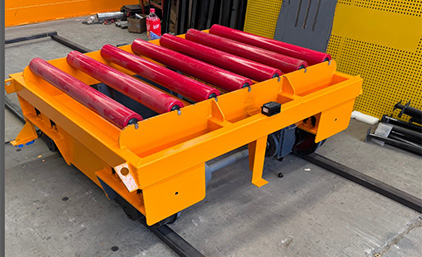
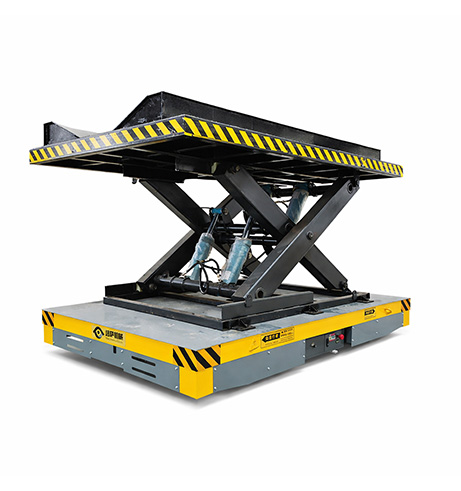
The core positioning of the rail transfer cart with rollers lies in its essential role in automated docking systems.
A well-designed system can significantly improve production efficiency in factories during pallet handling and transfer processes. In some warehouses and manufacturing environments, companies face the dual challenge of achieving efficient connection and smooth material transfer. Traditional manual handling methods or standard rail carts often lead to pallet tilting, cargo damage, and even disruptions in automated production lines due to inaccurate positioning and unstable transfers.
Rail transfer carts equipped with rollers address these issues effectively. With a roller-equipped platform design, they ensure smooth material receiving and transfer, perfectly adapting to continuous production in automated workshops and high-frequency material handling in warehouses. They serve as a flexible connecting link between different production and logistics systems.
Core Design Principle: Rollers + Rails for Smooth Docking
The key advantage of the rail transfer cart with rollers comes from the combined design of rail guidance and roller platform.
The rail system provides a precise travel path for the equipment. Through single-rail or double-rail configurations, the lateral deviation during operation can be controlled within ±2 mm, ensuring accurate positioning during docking.
The roller system installed on the platform is responsible for material transfer. The rollers are made of high-strength polyurethane, offering excellent wear resistance and load-bearing capacity, while also effectively absorbing impact forces during loading and unloading.
Depending on operational requirements, rollers can be classified into two types:
Powered rollers: Driven by a motor, they actively transport pallets and enable synchronized transfer with docking equipment, achieving powered material connection.
Passive rollers: Rely on the weight of the load or external pushing force, suitable for short-distance and light-load transfer applications.
Application Scenarios
Rail transfer carts with rollers are widely used in automated production and warehousing systems and have become a key hub for multi-equipment coordination:
Automotive parts workshops: They connect stamping machines and assembly lines. The roller platform supports pallets carrying stamped metal components, enabling direct and precise transfer to assembly stations without manual handling.
Electronic component workshops: For precision component handling, the carts are equipped with anti-static rollers and a soft start/stop system to prevent electrostatic damage and reduce vibration during transport, ensuring safe handling of sensitive parts.
Updates (2026.5.8)
Rail Transfer Cart with Rollers – Four Core Advantages
Compared with traditional material handling equipment, roller rail transfer carts offer significant advantages in automated environments:
Higher docking efficiency: No manual assistance is required during transfer. Pallets can be directly exchanged between systems via the roller platform, reducing docking time to within 30 seconds—up to three times more efficient than manual handling.
Greater operational stability: The combination of rail guidance and roller cushioning reduces the material damage rate to below 0.1%, significantly lower than the approximately 1.5% observed in forklift handling.
Wide adaptability: Track length and platform size can be fully customized according to workshop layouts. The system supports integration with AGVs, robotic arms, and automated storage systems, meeting diverse industry requirements.