When purchasing a transfer cart for your factory, selecting a manufacturer with strong customization capabilities is essential.
If you choose a manufacturer that cannot provide customized solutions, you may encounter several major problems:
The cart may not be suitable for narrow aisles or limited turning spaces;
The rated load capacity may be unnecessarily high, making operators hesitant to use the equipment at full capacity;
Incorrect cargo dimensions may result in unstable loading or cargo slipping;
The equipment may not be compatible with the specific working environment of your workshop.
Although a standard transfer cart may meet short-term requirements, it can eventually reduce handling efficiency and increase the risks of equipment failures, safety issues, and replacement costs.
Compared with standard off-the-shelf products, selecting a professional custom transfer cart manufacturer is a more economical procurement strategy that better supports your factory’s long-term production requirements.
As a manufacturer specializing in customized transfer carts, PEISA invites you to learn more about the key parameters that can be tailored to your application.
1. Customized Design Ensures Better Compatibility with Working Conditions
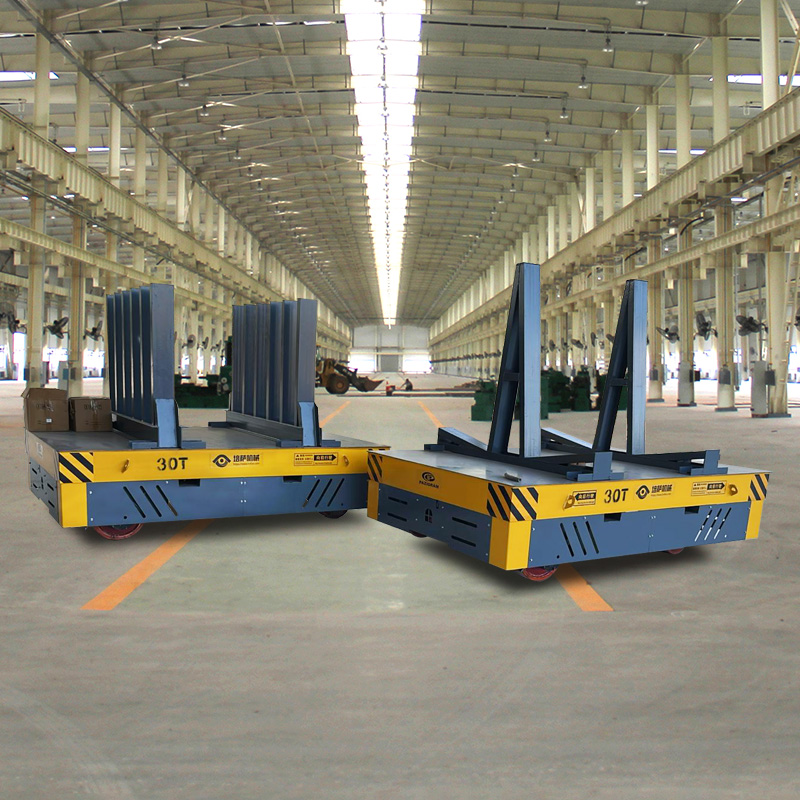
The core advantage of a custom transfer cart manufacturer is the ability to design equipment according to specific operating conditions and transportation environments.
Every factory has its own unique workshop layout and handling requirements. Some factories have narrow aisles and limited turning areas; others require transportation between different workshops, including movement on slopes. Some applications involve special materials such as heavy molds, long steel profiles, or precision components.
Custom transfer carts are designed according to specific aisle widths, floor conditions, transportation distances, and cargo requirements. By optimizing dimensions, wheelbase, steering systems, and platform structures, the equipment can better adapt to the working environment and effectively solve problems related to movement, loading and unloading, and transportation stability.
2. Customized Configuration Provides the Right Load Capacity and Functions
Customized production allows the load capacity and equipment functions to be accurately matched to actual requirements, avoiding unnecessary overspecification or insufficient capacity.
Standard transfer carts often have two common problems: using a low-capacity cart for heavy loads, which causes accelerated wear and frequent failures due to overload operation; or selecting a high-capacity cart for lighter loads, which increases equipment investment and energy consumption unnecessarily.
A professional custom manufacturer can configure the rated load according to the factory’s maximum daily handling requirements while adding a reasonable safety margin without excessive design.
In addition, functions can be selected according to actual application needs, avoiding unnecessary costs. For example:
Transfer carts for precision components can be equipped with anti-slip devices, shock absorption systems, and positioning mechanisms;
High-frequency assembly lines can be equipped with automatic start-stop functions and collision avoidance sensors;
Workshops with high temperatures, dust, or humidity can be equipped with dust-proof, waterproof, or explosion-proof designs.
This ensures that each transfer cart is designed specifically for its working environment.
3. Customized Manufacturers Provide Better After-Sales Support and Long-Term Compatibility
Custom transfer cart manufacturers can provide better solutions for after-sales service and future equipment compatibility, which are often overlooked by many companies.
Standard transfer carts on the market are often supplied through distributors. Due to product standardization, they may lack optimization for specific applications. This can result in longer repair times, compatibility problems, and increased maintenance costs during long-term operation.
In contrast, professional custom transfer cart manufacturers control the entire process, including design, manufacturing, assembly, and commissioning. This ensures clear equipment specifications and reliable spare parts support.
When equipment problems occur, manufacturers can provide faster technical support, accurate maintenance solutions, spare parts supply, and future upgrade services.
If production lines or workshop layouts are modified in the future, existing equipment can often be upgraded or adjusted instead of being completely replaced, reducing renewal costs.
4. Customized Equipment Provides Higher Safety and Durability
Customized transfer carts also have significant advantages in safety and durability compared with standard models.
To reduce costs, some standard carts may use simplified materials, welding processes, or electrical configurations. During high-frequency and long-term operation, problems such as frame deformation, motor overload, or braking failures may occur.
Professional custom manufacturers design equipment according to operating frequency and working intensity. They can optimize the structure with thicker steel plates, wear-resistant wheels, high-quality motors, and reliable electrical systems.
At the same time, safety features can be configured according to actual working conditions, including pedestrian traffic, operating environment, and transportation requirements, helping improve operational safety and reduce handling risks.
Conclusion
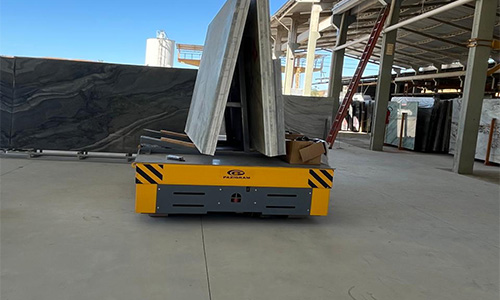
When purchasing industrial transfer carts, companies should look beyond the initial purchase price and consider long-term compatibility, reliability, and operating efficiency.
While standard models may be suitable for simple material handling applications, customized transfer carts are better aligned with the unique requirements of different factories, providing accurate adaptation, higher efficiency, longer service life, and reliable after-sales support.
Although the initial investment may be slightly higher, customized solutions can effectively solve problems such as poor equipment compatibility, frequent failures, and resource waste, making them the ideal choice for factories seeking cost reduction, improved efficiency, and stable production.


