What Types of Coil Transfer Carts Are There?
How to Choose a Coil Transfer Trolley?
Trackless vs. Rail-Mounted Models
The classification of coil transfer carts/trolleys is quite straightforward. The key differences mainly come down to two factors: the operating method and the power supply system.
Today, let’s explain the two main categories in simple terms, including their advantages and the working environments where each type performs best.
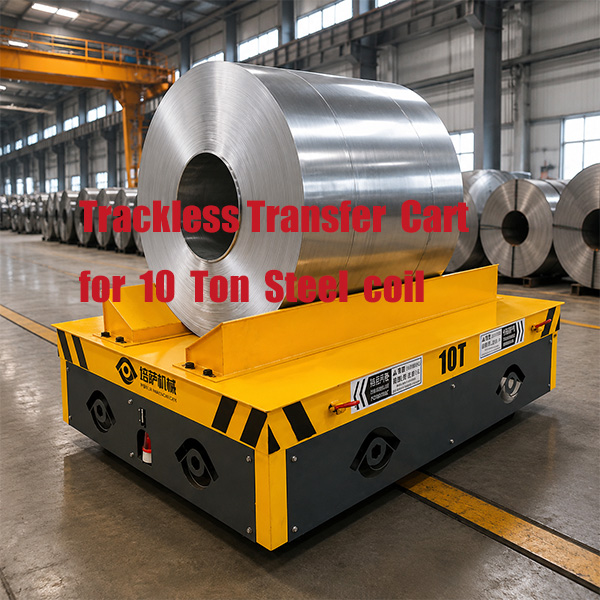
All coil transfer carts on the market can generally be divided into two categories: trackless transfer carts and rail-mounted transfer carts. Each type is designed for different workshop conditions and transportation requirements.
First, let’s take a look at the DWP Series trackless transfer cart, which is currently one of the most widely used models. These carts can be powered by either batteries or cables. Based on years of customer feedback, more than 90% of users choose the battery-powered version, making it the preferred solution for flexible material transportation inside factories.
The biggest advantage of the DWP battery-powered trackless transfer cart is its excellent flexibility and unrestricted movement. It does not require fixed rails and travels directly on the workshop floor with solid rubber wheels. The cart can move freely to different areas of the workshop without being limited by fixed transport paths. Since there is no external power cable, problems such as cable entanglement, cable dragging, or tripping hazards can be avoided, improving both safety and operational flexibility.
This type of cart is especially suitable for applications with multiple loading and unloading points, changing transportation routes, or frequent adjustments to production layouts. Its high adaptability makes it an ideal choice for many small and medium-sized workshops.
Cable-powered trackless transfer carts have a lower initial cost; however, the power cable limits their operating range and reduces convenience during daily operation. Therefore, they are mainly selected by customers with relatively simple transportation requirements.
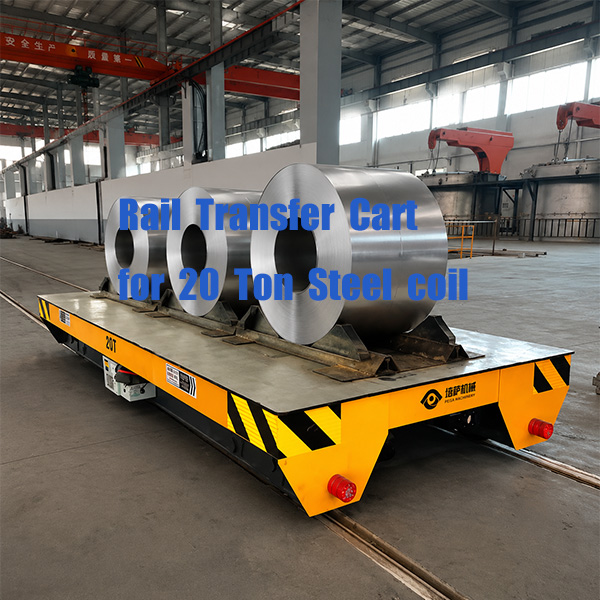
The second major category is rail-mounted coil transfer carts. These systems require dedicated rails to be installed in advance. Although their transportation routes are fixed, they provide excellent stability and higher load capacity, making them particularly suitable for large-scale and high-frequency material transportation along predetermined routes. According to the power supply method, rail transfer carts are mainly divided into three series.
The first type is the DPX Series battery-powered rail transfer cart. Powered by rechargeable batteries, it combines the stability of rail guidance with a certain level of operational flexibility. No external power cables are required; once the rails are installed, the cart is ready for operation. It also offers lower costs for future modifications and maintenance, making it suitable for most standard rail transportation applications.
The second type is the DPJ Series cable-powered rail transfer cart, which receives power through a cable system. It features a simple structure, reliable performance, and a long operating range. As long as the power supply system remains available, the cart can continue operating for extended periods, making it suitable for applications requiring long-distance and continuous transportation. However, because the cable moves together with the cart, proper cable protection measures are required to prevent wear, damage, or operational interference.
The third type is the DDG Series low-voltage rail-powered transfer cart, which provides the highest level of stability among rail-mounted transfer carts. It receives power through low-voltage electricity supplied by the rails, offering enhanced safety and eliminating the risk of high-voltage electrical hazards. With continuous power supply and stable operation, it is capable of handling heavy-load transportation and long-duration working conditions. This type of transfer cart is widely used in large steel mills, metallurgy plants, and heavy-duty manufacturing facilities where heavy materials need to be transported along fixed routes.


